Open an investing account with Wisebanyan (now Axos Invest)

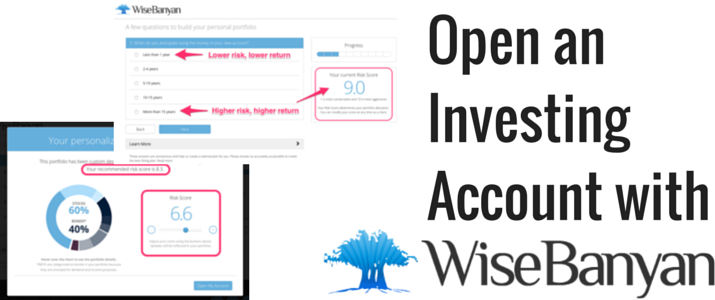
Title image for article that reads 'Open an investing account with Axos Invest'.

Title image for article that reads 'Open an investing account with Axos Invest'.

If you’re a friend of mine and you don’t have a retirement account setup yet, I want you to open one today. Yes today. Right now. Hopefully you have $5,500 sitting in a savings account or CD earning you nothing right now. Why $5,500? Because that’s the maximum you can contribute to a ROTH IRA which is the retirement account you want to open (if you earn less than $183,000, which I’m pretty sure you do).

I’m going to help you put that money to work for you by opening an investment account with Axos Invest. There are tons of investing brokerages, but I’m going to highlight one of the easiest places to open an investing account today. You’re going to open it, answer some questions, send your savings there, and let it sit for a year. If you’re not happy with it after a year, you can take it back it and put it back where you have you now. But I’m confident you’ll be so happy with the result after a year, you’ll not only keep your money there but you’ll add more to it.

Read more

The 4 best options to travel in Asia for the first time

An image of the Golden Pavilion in Kyoto, Japan.

An image of the Golden Pavilion in Kyoto, Japan.

So you want to travel in Asia for the first time. Where should you go? What are the best countries and destinations for your first trip to Asia. Well, I’ve traveled to most of the countries in SE Asia and I’d like to help you out. But there’s no easy answer. Here are four options for first time travelers to Asia.

  1. The Big Two – Japan and China
  2. Beach & Scuba – Philippines & Bali
  3. Elephants & Angkor Wat – Thailand, Cambodia
  4. Big City Tour – Hong Kong, Singapore, Shanghai

Before you decide, it depends a lot on what you’re looking for and how long you have. You might want to hit the big ones – China and Japan. Or you might want to hit the cheap ones – Thailand, Cambodia. You might want culture, or you might just want beaches. Here are a couple thoughts to consider before you decide where to travel in Asia your first time.

Read more

Tony Robbins wants you to invest now

Image of Tony Robbins meditating with a speech bubble that says "Get in the game."

Image of Tony Robbins meditating with a speech bubble that says "Get in the game."

Everybody loves Tony Robbins, right? The guy is a superhuman. So when he published his first book in almost 20 years and it wasn’t about peak potential or flow, but about how to win in the money game, people took notice. Well, don’t go out and buy the book just yet. It’s 688 pages and has mixed reviews. Let me help distill his best advice into something more easily consumable. Here are some of the better takeaways from an interview he did with Inc. (video after the break).

Read more

Why investing beats savings accounts

A chart showing the growth of $10,000 invested and saved.

A chart showing the growth of $10,000 invested and saved.

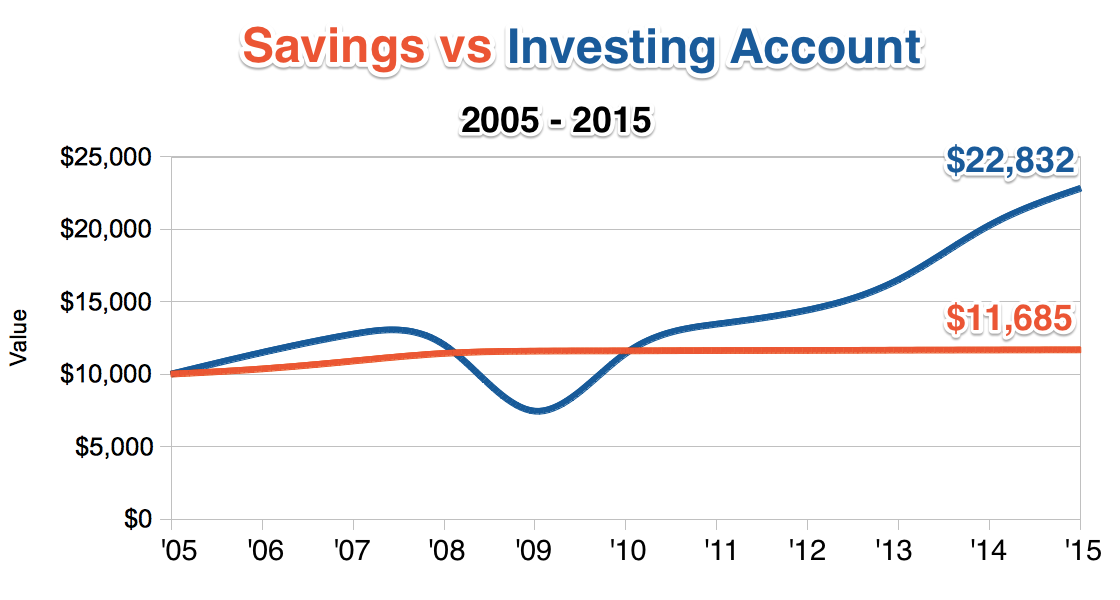
I hope this chart is self-explanatory. But in the case that it might not be. Let me explain it for you. If you had $10,000 in March of 2005, this is how much money you’d have if you had either put it into a savings account (red/orange line) or had invested it in the stock market (blue line).  It’s 2015 now and 10 years later, this is how much money you’d have in your account. Which would you prefer? This chart shows why an investment account is better than a savings account.

So, if you’ve paid off your debts, saved up a couple $1,000 and now you’re curious about how to put that money to work, look no further. You’re asking yourself, “what should I do with X dollars?” Should you invest in the stock market or put it into a savings account? Look at that chart and you tell me.

Read more

Rise of the financial robo-advisors

An image of logos for Betterment, Wealthfront, and Wisebanyan and the text Rise of the Robo-advisors.

It should be obvious by now that the internet is shattering traditional businesses by democratizing access to information and allowing for technology to reduce costs and simplify transactions. Well the newest target of advancing technology on the internet is the financial advisor. With the rise of robo-advisors like Betterment, WealthFront, and now Wisebanyan, the traditional brick-and-mortar financial advisors are looking like Radioshack and Barnes and Noble of the early 2000’s (that is to say not likely to last much longer). Intelligent Gen-X’ers (born in the 60’s and 70’s) and Millennials (born between 1980 and the 2000’s) are comfortable with technological disruptors and overall tend to embrace them. And the rise of robo-advisors for under 40’s will be another disruptor.

Read more

Tony Robbins Stronghold Financial review – caution

Image from the front of the Stronghold financial website showing Tony Robbins.

Image of the Stronghold Financial homepage with Tony Robbins face.

This is a review for the new tool endorsed by Tony Robbins by Stronghold Financial that apparently gathers your investment portfolio details and compares them to an asset allocation laid out by the investment firm, Stronghold Financial Group. (Update: It’s now called Portfolio Checkup by Creative Planning. I guess negative reviews forced them to rebrand?)

Like many others in my generation (young 30’s), I found out about Stronghold Financial from listening to a Tim Ferriss interview with Tony Robbins (listen here on iTunes, or on Tim’s site here) . Tony Robbins is a ridiculously inspiring human and listening to him speak about anything will light a fire under your tail and make you want to live a better life and be a better person.

Read more

Super easy 7-layer dip for your Super Bowl party

Image of a Mexican 7 layer dip.

Just like every group of friends needs the friend who usually hosts a Super Bowl Party, you also need the friend who brings that awesome 7 layer dip. If you don’t have that friend, now’s your chance to guarantee an invite to every ‘bring a dish’ party your friends throw – become that guy (not “that” guy).

I’m not going to make you “cook” anything. You don’t have to do anything other than buy the ingredients and layer them. Literally, I’m going to give you the easiest 7 layer dip recipe that you might actually search this site for more awesome recipes – sorry, I’m not a stay-at-home Dad with nothing better to do. This is the only recipe you’re going to get.

Let’s get to it.

Read more

Open a Roth IRA: what it is, why it matters, and how to start

If you haven’t opened a Roth IRA yet, do it this week. It is one of the best financial decisions you can make, and most people wait far too long to start.

What is a Roth IRA?

A Roth IRA is a type of individual retirement account with a key tax advantage: your money grows tax-free, and qualified withdrawals in retirement are also tax-free. You contribute money you’ve already paid taxes on, so you never pay taxes on the growth.

Compare that to a traditional IRA or 401(k), where you get a tax break now but pay taxes on everything when you withdraw in retirement. The Roth flips that: you pay taxes now (on a smaller amount) and never again.

Why the Roth is so powerful

The magic is compound growth over time. When your investments grow for 20 or 30 years without being taxed, you end up with significantly more money than the same investments in a taxable account.

Here’s a simple example. If you invest $6,000 per year starting at age 25 and earn a 7% average annual return, by age 65 you’d have roughly $1.3 million. In a Roth IRA, you’d owe zero taxes on that. In a taxable account, you’d owe capital gains taxes as you withdraw.

A Roth IRA also has some useful flexibility that other retirement accounts don’t:

  • You can withdraw your contributions (not the earnings) at any time, for any reason, with no penalty or taxes. This makes it useful as a backup emergency fund if needed.
  • There are no required minimum distributions at age 73, unlike traditional IRAs and 401(k)s.
  • You can keep contributing as long as you have earned income, with no age cutoff.

Who can contribute to a Roth IRA?

You need earned income to contribute, meaning wages, salary, or self-employment income. Investment income doesn’t count.

There are also income limits. For 2024, the ability to contribute phases out for single filers earning between $146,000 and $161,000, and for married couples filing jointly between $230,000 and $240,000. If you’re under those limits, you can contribute the full amount.

The annual contribution limit for 2024 is $7,000 if you’re under 50, and $8,000 if you’re 50 or older.

Where to open a Roth IRA

The best places to open a Roth IRA are low-cost brokerages that offer index funds:

  • Fidelity is a top choice with zero-fee index funds, no account minimums, and an easy-to-use platform.
  • Vanguard pioneered low-cost index investing and remains excellent for long-term investors.
  • Schwab is another strong option with no minimums and competitive funds.

Avoid banks that only offer savings accounts inside the IRA wrapper. You want access to stock and bond index funds so your money can actually grow over time.

What to invest in once you open it

Keep it simple. Put your Roth IRA money into one of these:

  • A total U.S. stock market index fund (like FSKAX at Fidelity or VTSAX at Vanguard)
  • An S&P 500 index fund (like FXAIX at Fidelity or VFIAX at Vanguard)
  • A target-date retirement fund based on your expected retirement year, if you want a single hands-off option

Pick one, set up automatic monthly contributions, and don’t check the balance obsessively. Time in the market beats timing the market.

How much should you contribute?

Max it out if you can. For most people in their 20s and 30s, this is the single best place to invest after capturing any employer 401(k) match.

If you can’t max it out, contribute whatever you can. Even $50 or $100 per month is worth starting. You can always increase it later. The important thing is to open the account and start the habit.

Open it today

The hardest part is the five minutes it takes to actually open the account. Go to Fidelity.com or Vanguard.com, click “Open an account,” and choose Roth IRA. You’ll link your bank account, transfer some money, and choose a fund. That’s it.

Every year you wait is a year of tax-free growth you don’t get back. Start now.
Make 2014 one of your best years ever

Happy New Year folks! 2014 is going to be probably one of the best years of my life. Hope it will be for you too. Here are some ideas to help you make that happen:red_wine_bottle_and_wine_glass

  1. Drink a bottle of wine instead of that beer or liquor.
  2. Fast every-now-and-then. Once a week isn’t too hard. (http://www.dailymotion.com/video/xvdbtt_eat-fast-live-longer-hd_shortfilms)
  3. Buy more fruit. Eat a banana in the morning. Have an orange when you’re hungry but it’s not quite lunch (10:30 am?). Blueberries and strawberries are always good.
  4. Learn something. Take a cooking class, a rock-climbing class, a yoga class, or learn to code (http://www.codecademy.com/), or learn a new language (http://www.livemocha.com/learn-spanish).
  5. Save some money and then spend it on yourself. (https://home.capitalone360.com/online-savings-account) Then save some money and don’t spend it. (https://www.scottrade.com/)
  6. Call your mom and tell her you love her. Call your pops, siblings, grandparents, and a few of those friends you haven’t spoken to in a while. Just ask ’em what’s up in their life. Then listen.
  7. Make a plan for the weekend. Go somewhere new an hour away or more. Hike a mountain, visit a historical site, go to a different beach, and take your favorite people with you. Make a plan.
  8. Volunteer. Give a few hours Saturday morning to help somebody. It can be your neighbor, your friend, your church, or a local charity. Offer your time and effort.

And make 2014 one of your best years ever!

Why you are broke even with a good income (a real budget example)

You don’t need a raise to stop being broke. You need to know where your money is going.

That sounds simple, but most people genuinely have no idea. They earn a decent income, make their payments, and still end up with nothing left at the end of the month. The problem usually isn’t income. It’s untracked spending.

A real-world budget example

A few years ago, a friend of mine was working in the music industry in Los Angeles. Good job, steady income, fun lifestyle. But he came to me frustrated because he was going deeper into debt every month.

After taking a look at his numbers, we figured out he had about $1,400 left each month after rent and utilities. Here’s how he was spending it:

  • Gas: $50/week = $200/month
  • Breakfast (fast food most mornings): $5/ea  = $100/month
  • Lunch (eating out daily): $8/ea = $224/month
  • Weekday dinner (takeout): $10/ea = $200/month
  • Weekend dinner (restaurants): $15/ea = $120/month
  • Cable and internet: $80/month
  • Cell phone: $80/month
  • Coffee: $50/month
  • Weekday alcohol (beer at home): $80/month
  • Going out Thursday through Saturday (drinks, rounds for friends): $600/month

Setting aside rent and a few other things, he was overspending by $334 every single month.

When I walked him through the numbers, his response was classic: “Yeah, I should probably stop buying those breakfast burritos.”

I laughed, but he was serious. His social life was clearly much more important than breakfast burritos. Even though eating out for breakfast was costing him $100/mo and alcohol was $680.

The lesson here

We almost always underestimate how much we’re spending in our biggest categories. The small daily purchases feel like the problem because they’re visible. The large habitual expenses become invisible because they’re routine.

My friend wasn’t doing anything unusual by LA standards. He was just spending more than he made, in a way that felt completely normal month to month.

The fix wasn’t a raise. He could have gotten a $5,000 a year raise and still ended the year deeper in debt. The fix was tracking his spending and making conscious choices about what mattered to him.

How to do your own budget

Go through each of these categories and estimate what you spend in an average month. Be honest. Guess high if anything.

  • Rent or mortgage
  • Utilities (electric, gas, water)
  • Groceries
  • Restaurants and takeout
  • Coffee
  • Alcohol
  • Gas
  • Car payment
  • Car insurance
  • Phone
  • Internet and streaming
  • Clothing
  • Personal care (haircuts, toiletries)
  • Entertainment and hobbies
  • Gym or fitness
  • Subscriptions
  • Anything else you spend money on regularly

Add it up. Compare it to your take-home pay. If the total is higher than your income, you’ve found your problem.

Spend less than you make

This is the whole secret to wealth. Not investment strategies, not side hustles, not crypto. Just spending less than you earn, consistently, over time.

Once you have money left over every month, you put it to work: emergency fund first, then debt payoff, then investing. But none of that is possible if your spending is higher than your income.

Look at your numbers. Find the real leak, not the breakfast burritos.